

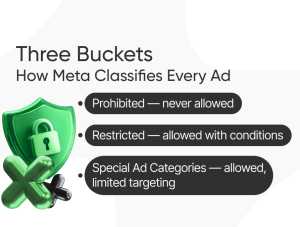
Most Meta ad rejections come down to one question: which of three buckets does your offer fall into? Meta sorts every ad into prohibited or unacceptable (never allowed), restricted (allowed if you meet specific conditions), and special ad categories (allowed, but with limited targeting). Get the bucket right before you build creative and you avoid most ad rejections before they start. Our comprehensive guide maps the Meta’s advertising policies for 2026 – what’s banned, what needs approval, how Special Ad Categories work, and what changed this year. Treat it as the plain-English Facebook ads rules – the Facebook guidelines for ads that decide whether your ad campaign will run or get pulled. P.S. One clarification up front, because it causes endless confusion: “restricted” means two different things. Restricted content is what this guide covers – the rules about what you can advertise. And a restricted account is a separate problem about your access being limited, with its own recovery process. P.P.S. And while people still say “Instagram or Facebook ad policy” or “FB ad policy”, these rules apply identically across Facebook, Instagram, Messenger and Threads – an Instagram ad restriction is the same Meta Advertising Standard as a Facebook one.
- What Meta’s Advertising Policies Actually Cover
- Prohibited (Unacceptable) Content – What You Can Never Advertise on Meta
- Restricted Content – What Requires Special Approval
- Sale-Prohibited Goods
- Permission- and Age-Gated Verticals
- Other Conditional Categories
- Special Ad Categories on Facebook and Instagram
- Housing Ads
- Employment Ads
- Credit Ads
- Social Issues, Elections, and Politics
- Unacceptable vs Restricted vs Special – How to Tell Which Applies
- Meta Ads Creative Rules That Trip Up Legitimate Advertisers
- Personal Attributes
- Misleading Claims and Income Promises
- Before/After and Health Imagery
- What’s Changed in Meta Ad Policies in 2026
- Why Meta Ads and Meta Ad Accounts Get Restricted for Policy Reasons
- How Tech4You Helps with Meta Ad Policy Compliance
- FAQ
What Meta’s Advertising Policies Actually Cover
Meta renamed its old Instagram and Facebook Advertising Policies, or as still widely called the Instagram or Facebook advertising guidelines, Facebook advertising rules or Meta ad guidelines, to Meta Advertising Standards. Three sets of rules apply at once:
- the Advertising Standards govern what you can advertise and how;
- the Community Standards set baseline safety rules for every piece of content on the platform; and
- Meta’s business and data terms control what information you can collect.
Ad rules are usually stricter than the organic ones, which is why content that lives happily as a post can still be rejected as an ad.
Two enforcement things trip up even experienced media buyers:
First, review is heavily automated, with human reviewers stepping in on some ads, and most ads are reviewed within about 24 hours, though some take longer. But approval is never permanent. Ads remain subject to review and re-review at any time, and the first review may not check an ad against every policy before it starts delivering – which is exactly why an ad can run for a week and then be pulled.
Second, the review system doesn’t just look at your creative. It evaluates the ad copy, the imagery or video, the targeting parameters, the landing page, and your identity as an advertiser, all together. A clean ad pointing at a non-compliant landing page is still a non-compliant ad.
Prohibited (Unacceptable) Content – What You Can Never Advertise on Meta
Prohibited content is the hard no. These categories cannot be advertised regardless of how you target, what disclaimers you add, or how cleverly you frame the creative. Meta Advertising Standards hold the full list; these are the categories that most often trip the review system:
| Category | What’s not allowed (examples) |
| Illegal or locally illegal products | Counterfeit or replica goods, fake documents and IDs, hacked accounts or stolen data, and anything unlawful in the market you’re targeting. |
| Discriminatory practices | Content or targeting that discriminates on protected characteristics like race, religion, age, sex, gender identity or disability. |
| Hateful conduct | Attacks on people based on protected characteristics – race, ethnicity, religion, caste, sexual orientation, gender identity, disability or serious disease. |
| Dangerous, exploitative or criminal content | Child sexual exploitation, abuse and nudity, praise or support of dangerous organisations, human trafficking, and content that coordinates harm or promotes crime. |
| Misinformation | Content debunked by Meta’s fact-checking programme or that violates its misinformation standards, and content that discourages vaccination, for example, fake “cure” claims. |
| Fraud, scams and deceptive claims | “Get rich quick” schemes, miracle cures, fake countdown timers, bait offers and results a typical user won’t get (the exact phrasing that triggers this, with compliant rewrites, is in the table later in this guide). |
| Prohibited financial products | Payday loans, paycheck advances, bail bonds, short-term loans of 90 days or less, initial coin offerings (ICOs), binary options and penny auctions. |
| Adult content and adult nudity | Nudity and sexually explicit material, escort or “sugar dating” services, and explicit sex toys. (Contraception and reproductive-health products are conditional – see next section.) |
| Sensational or shocking content | Graphic violence, gore, accident or injury imagery, and shock tactics designed to provoke a strong negative reaction. |
| Intellectual-property infringement | Using another brand’s name, logo, copyrighted images, music or characters without rights, or counterfeit goods. |
| Personal attributes | Copy that asserts or implies a private trait about the viewer – health, age, finances, sexual orientation or group membership (see the bad/good examples later in this guide). |
| Non-functional or low-quality content | Broken or mismatched landing pages, deceptive layouts, excessive caps or profanity, and disruptive audio or animation. |
| Spyware, malware and surveillance tools | Stalkerware and “catch a cheater” spy apps, hacking tools, and fake virus or system-warning ads. |
| Suicide, self-injury and eating disorders | Content that encourages or depicts suicide, self-injury or eating disorders – including memes or illustrations – or that mocks victims or survivors. |
Meta spreads these rules across the Advertising Standards and topic pages rather than one master list, so this table is a curated summary, not a verbatim enumeration. When an ad is rejected, check the exact policy line cited in Account Quality.
Restricted Content – What Requires Special Approval
Instagram and Facebook ads restricted content is where most rejections actually happen, because the offer is allowed – advertisers just miss the conditions attached to it. These are the Instagram and Facebook ad restrictions (or Meta ads restrictions) most advertisers run into.
Meta’s restricted goods and services policies let these categories run only with the right combination of prior written permission, a license or certification, age-gating, geographic limits, or mandatory disclosures.
Sale-Prohibited Goods
A handful of these sensitive categories can’t be advertised for sale or promote their use at all – no permission, licence or disclosure unlocks them. Here’s what each one covers and where the rare exceptions sit:
No ads for the sale or use of tobacco, nicotine or related paraphernalia – cigarettes, cigars, smokeless tobacco, heated-tobacco products and every kind of “ENDS” (e-cigarettes, vape pens, oils and cartridges, plus nicotine-free and “wellness” vapes). The only opening is for WHO- or FDA-approved smoking-cessation products (patches, gum), targeted to 18+. Vapes are never allowed, even as cessation aids; tobacco may be referenced only in anti-smoking contexts.
No ads promoting the sale or use of firearms, firearm parts, ammunition, explosives or weapon-modification accessories (silencers, suppressors). The ban reaches beyond guns to BB and paintball guns, self-defence tools (pepper spray, tasers, batons), non-culinary blades, and any content teaching weapon assembly, including 3D-printed firearms. Licensed brick-and-mortar retailers may promote firearms sold off-platform, but only to audiences 21+; safety courses and accessories like holsters run to 18+.
No ads for items that pose a safety risk – fireworks and other explosives, and flammable, radioactive or toxic substances. Fireworks may appear only in a celebratory, non-violent context that doesn’t offer them for sale.
No ads promoting the sale of human organs, body parts, blood or other bodily fluids, in any form, except for a donation of human fluids such as semen or blood plasma.
No ads promoting the sale of historic artefacts or antiquities – a rule aimed at looted and trafficked cultural property.
No ads for products derived from threatened or endangered species (wildlife or plants – ivory being the textbook example), and no peer-to-peer sale or trade of live animals. Live non-endangered animals may be offered only for donation, rehoming or adoption.
No ads for the sale or use of illegal or recreational drugs, or related paraphernalia (bongs, rolling papers). High-risk drugs like cocaine, fentanyl and heroin are treated most severely. Prescription, OTC and CBD products sit under separate conditional rules below.
Not a product but a prohibited tactic: ads must not exploit crises, tragedies or controversial events for commercial gain.
The rest are conditional – allowed once you meet the rigid Meta’s requirements. Here’s how the major ones work:
Permission- and Age-Gated Verticals
These products are legal to advertise, but only once you clear a gate – a written permission, a licence, age-gating, or all three:
Allowed, but you must follow local laws on legal drinking age and where alcohol can be promoted. Minimum-age targeting varies by market – 18+ in most jurisdictions and higher in others (for example, 19+ in parts of Canada) – and cross-border delivery that leaks into a stricter market can itself trigger rejection. This is why brands like Heineken and Diageo advertise heavily on Meta without issue – they age-gate and geo-restrict by design.
Real-money gambling – betting, casino games, poker, lotteries, fantasy sports, sweepstakes, anything where money goes in and can come out – runs only with prior written permission from Meta. Permission is granted only in eligible countries, never targets under-18s, and excludes Meta’s prohibited markets – the advertiser carries full responsibility for local compliance – the model operators like DraftKings, FanDuel and Bet365 run at scale. A few cases run without permission: offline casinos, advertiser-run government lotteries, and free-to-play social casino games whose “coins” hold no monetary value.
Allowed only with prior written permission from Meta, subject to Meta’s dating-specific guidelines and targeting requirements, and limited to 18+ – the route Match Group brands like Tinder, Hinge and Match take.
Meta’s cryptocurrency advertising policy allows ads only with prior written permission and a recognized regulatory license submitted through the Authorizations and Verifications tab. Education, news and blockchain content without a tradeable product can run freely; exchanges, trading platforms and functional wallets cannot. Facebook banned all crypto ads in 2018 after a wave of ICO scams, then reversed course into today’s license-gated system, which a regulated exchange like Coinbase operates within.
Permitted with clear disclosures and no misleading promises of returns. Loans, investments and insurance face extra scrutiny, and in the US, these now intersect with Special Ad Categories (more below).
Prescription drugs and online pharmacies require LegitScript certification. CBD is allowed only in narrow circumstances – in the US, with LegitScript certification and prior written permission, targeting 18+, and with no health or medical claims. THC and psychoactive cannabis remain prohibited, and hemp products that aren’t CBD are limited to Canada, Mexico and the US. Without that certification and permission, the safe play is to advertise brand and education and route purchase intent to your own site rather than selling restricted ingestibles directly.
Other Conditional Categories
A further set of verticals is allowed but conditional, each with its own gate:
General and OTC supplements can run, but unsafe or prohibited substances (anabolic steroids, certain weight-loss compounds) cannot; some require 18+ targeting, and health claims draw extra scrutiny.
In the US, these require LegitScript certification and Meta’s written permission before they can run.
Allowed with 18+ targeting and no content that generates negative self-perception; before/after weight-loss imagery is restricted (more in the creative section).
Contraception and family-planning products are allowed with 18+ targeting when the focus is the product and its health benefit, not sexual pleasure.
Allowed only with clear, upfront disclosure of billing terms – renewal, price and cancellation.
Paid-partnership and influencer ads are allowed but must be tagged through Meta’s branded-content tool to disclose the commercial relationship.
So “restricted” isn’t a synonym for “allowed”: some categories can’t be advertised for sale at all, the rest are conditional – and either way, confirm your exact category against the Transparency Centre before launch.
Special Ad Categories on Facebook and Instagram
Special Ad Categories work differently from everything above. These aren’t about what you advertise – the products are perfectly legal – but about how Meta lets you target them. They exist to prevent discrimination, after civil-rights settlements (including a 2022 US Department of Justice agreement over housing ads) pushed Meta to strip demographic targeting from these verticals.
Wondering how to choose a special ad category? You don’t pick one from a menu – Meta makes you declare it. If your ad falls into one of four areas, you must self-declare the category at the campaign level, after which Meta automatically limits your targeting: no targeting by age, gender or ZIP/postal code; a minimum location radius (15 miles / roughly 24 km in the US); a restricted detailed-targeting list that removes options tied to protected attributes; no standard lookalike audiences; and certain Advantage+ audience features are unavailable.
Special Ad Audiences, the old workaround, can no longer be created. The audience limits for housing, employment and credit ads apply the moment the category is set in Ads Manager, and failing to declare when Meta’s systems determine you should have can put the whole ad account at risk.
Housing Ads
This covers ads for housing that promote or link to a housing opportunity: home and apartment sales or rentals, mortgages and mortgage insurance, homeowner’s insurance, home equity and appraisal services, and related listings. A real-estate marketplace like Zillow or Redfin, or any agency advertising listings, has to run these under the housing designation with the targeting limits applied.
Employment Ads
When you run ads for employment, job listings, internships, recruitment and certification programs fall here. A staffing agency or any employer promoting open roles must declare the employment category – even an “we’re hiring” brand-awareness ad qualifies if it points to a job opportunity.
Credit Ads
Credit card offers, personal and business loans, long-term financing and “buy now, pay later” products belong to the credit ad category. Brands like American Express, Klarna or Affirm advertise under it. Since January 2025, US advertisers promoting a broad range of financial products and services must use this category, widening it well beyond traditional credit.
Social Issues, Elections, and Politics
Political and issue-based advertising is the most heavily regulated category, requiring identity authorization, a “Paid for by” disclaimer, and inclusion in Meta’s public Ad Library. And this is where European advertisers face additional rules here.
Regulation (EU) 2024/900, the political-advertising transparency regulation (TTPA), has been in full application since 10 October 2025: ads must be labelled with who paid and how much (the payer and beneficiary transparency fields), targeting needs explicit consent and first-party data, non-EU sponsors are banned in the three months before an election, and fines reach 6% of worldwide turnover. It runs alongside the Digital Services Act (DSA), whose ad transparency requirements apply in parallel, and GDPR. The result is the clearest case of policy reshaping a market – Meta stopped allowing political and issue ads across the EU from October 2025, and Google had already exited EU political ads in late 2024. If an EU campaign could be read as issue-based, confirm it can run against the Commission’s guidance before committing a budget.
These Special Ad Category rules apply to advertisers in or targeting the United States, Canada and parts of Europe, and Meta’s systems automatically classify many ads, so if your offer touches housing, jobs, credit or politics, expect the category to apply whether or not you declare it.
Unacceptable vs Restricted vs Special – How to Tell Which Applies
When you’re unsure where an offer lands, run it through three questions in order:
- Is it unacceptable content – discrimination, hateful conduct, fraud or deceptive claims, adult or shocking content? Or a sale-prohibited good like tobacco, weapons, drugs or human body parts? If yes, it can’t run. Stop.
- Is it a conditional good or service – does it need permission, a licence, a certification, age-gating or disclosures (alcohol, gambling, crypto, CBD, financial products)? If yes, it’s restricted. Get the condition met before launching.
- Is the product legal but socially sensitive – housing, employment, credit or politics? If yes, it’s a Special Ad Category. Declare it and accept the targeting limits.
This is the difference between prohibited (unacceptable) and restricted content that confuses so many advertisers: prohibited is a wall, restricted is a gate with a key, and special categories are open doors with narrower hallways. Most rejections happen in bucket two, because people treat a gate like an open door.
Meta Ads Creative Rules That Trip Up Legitimate Advertisers
Most ad rejections don’t come from selling something banned – they come from how a legally compliant ad is written or framed. Three patterns account for the bulk of them, and all are fixable in the copy before you ever submit.
Personal Attributes
Meta’s personal-attributes rule rejects more copy than almost any other. Your ad can’t assert or imply that you know something private about the person seeing it – a health condition, a disability, age, financial status, sexual orientation, or membership in any sensitive group. The trigger is almost always the word “you”. The fix is to move from “you have” to “people who want,” reframing a diagnosis as an interest. Gut-check: if a stranger reading the headline would think “how do they know that about me,” rewrite it.
| Not allowed | Compliant rewrite |
| “Are you struggling with diabetes?” | “Resources for people managing diabetes.” |
| “Living with anxiety? This helps.” | “Support for calmer, steadier days.” |
| “Tired of your acne?” | “A skincare routine for clearer-looking skin.” |
| “Your hearing loss doesn’t have to slow you down.” | “Hearing support designed for everyday life.” |
Misleading Claims and Income Promises
Meta rejects ads that are likely to deceive: exaggerated results, fake countdown timers, features the product doesn’t have, bait pricing, and outcomes a typical user won’t get. Money-making offers draw the harshest scrutiny because they overlap with scams. Specific earnings promises – “make $500 a day“, “replace your salary in 30 days” – are banned, while an honest description of a skill, tool or business model whose result depends on the user’s effort is allowed.
Some phrasing reliably triggers the classifier no matter what you’re selling. Here are common red-flag phrases and a compliant way to say the same thing:
| Avoid | Use instead |
| “Cures, treats or prevents [a disease]” | “Supports your wellness goals; formulated for everyday use” |
| “Miracle cure” / “doctors hate this trick” | “A research-backed approach to [goal]” |
| “FDA approved” (when it isn’t) | Drop the claim or, only if true, “made in an FDA-registered facility” |
| “Guaranteed income” / “risk-free returns” | “Build the skills to earn freelance income – results depend on your effort” |
| “Make $500 a day from your phone” | “A flexible way to earn from [skill] on your own schedule” |
| “You won’t believe what happens next” | “See how [product] works” |
| “You’ve been selected — claim your prize” | “Check if you qualify” / “Apply for [offer]” |
Lead with what someone learns or builds, not what they’ll earn, and move any proof to a landing page you control.
Before/After and Health Imagery
The before/after rule is more specific than “never.” Side-by-side before/after comparisons are prohibited for weight loss and for anti-aging or wrinkle treatments, along with close-ups like pinching fat or a tape measure around a waist, and anything that generates negative self-perception.
General cosmetic products and procedures can show a before/after as long as they avoid those tactics, and fitness services – a Pilates or strength class – are treated more leniently than diet-pill transformations. For weight loss, show the product in use or a confident lifestyle image rather than a body transformation; for skincare, show the formula and routine and describe realistic results over time.
One related note: Meta retired the old 20%-text-in-image limit, so heavy text no longer blocks an ad outright – but it can still reduce delivery, so keep overlays light.
What’s Changed in Meta Ad Policies in 2026
It’s worth separating two things that sound alike. Policy changes govern what you can advertise; algorithm changes govern how your ads are delivered and priced. The delivery side is a question about Meta 2026 ad algorithm changes, not its policies; this section stays on policy.
The headline Meta ad policy update for 2026 is enforcement, not a new list of bans. Meta is expanding advertiser verification, so that verified advertisers drive 90% of its ad revenue by the end of 2026, up from 70%, with the highest-risk categories – finance, crypto, investment – covered first. Meta also reported removing more than 159 million scam ads in 2025, most of them before anyone reported them, and now runs advanced AI that analyses text, images and surrounding context together to catch deceptive ads at scale. The European political-ad rules described above came into force in the same window, prompting platform-wide withdrawals.
Beyond that, advertisers report tighter enforcement on misleading claims, before/after imagery and personal attributes language, plus a review process that increasingly assesses creative, copy, targeting and landing page as a single unit. Where you see specifics circulating about crypto “tiers” or country blacklists, treat them as third-party reporting and confirm against Meta’s Transparency Center before relying on them, since they aren’t spelled out in Meta’s published standards.
Why Meta Ads and Meta Ad Accounts Get Restricted for Policy Reasons
Meta ad policy problems rarely stop at a single rejected ad. A pattern of rejections, repeated restricted-category violations, or a landing page that doesn’t match the ad escalates – first to limited ad account functionality (an advertising restriction), then to a disabled asset. The mechanics of why Facebook ad accounts get disabled and how to set accounts up to avoid bans are a topic in their own right. The short version for this article: clean content keeps your ad account healthy, and content is the lever you control most directly.
How Tech4You Helps with Meta Ad Policy Compliance
For advertisers running serious budgets in high-moderation niches, the gap between “compliant in theory” and “live and scaling” is where ad campaigns are won or lost – and it’s the gap Tech4You can help to close. We don’t help anyone push prohibited content live; we help legitimate businesses in tightly-moderated verticals build the right advertising infrastructure and pre-launch review that lets compliant ad campaigns run without constant interruption. In practice, that means:
- Pre-launch policy review and funnel optimization: creatives and funnels are checked against Meta’s Advertising Standards and guided through creative moderation before they ever reach the review system, so ad rejections get caught on our side, not Meta’s.
- Whitelisted Meta agency ad accounts: official and verified agency ad accounts across multiple GEOs, including European BMs, directly relevant for advertisers navigating EU rules and restricted categories.
- Direct access to platform representatives: direct lines to Meta and other advertising platforms that dramatically speed up resolving rejected creatives and flagged or banned ad accounts.
- Instant automated alerts: ad account status is checked roughly every 10 minutes, with notifications on rejected ads, banned ad accounts and low balances, so issues surface in minutes rather than days and you don’t lose money to a ban you spotted late.
- Exclusive policy insights: a closed client community where our partners are first to hear about changes to Meta advertising policies, emerging trends and best practices, before the wider market does.
- Financial partnership and leverage: a low-interest credit line, financial leverage and overdraft support keep compliant ad campaigns running without funding gaps, even if a top-up runs late.
- TechHub CRM: a single dashboard to manage all your ad accounts, budgets and campaigns in one place.
Proven Track Record of Expertise:
We bring over 6 years of vast experience across various verticals and can boast more than 100 satisfied clients as at 2026. Our portfolio includes such clients as SPI Dubai, OMG Agency, SmartyAds, Ye Bookstore, First Visa Services, and other well-known brands across Europe, UAE, Ukraine, and USA..
The advertisers who survive Meta’s 2026 enforcement treat compliance as infrastructure – clean accounts, pre-launch review, and a working knowledge of how the rules shift quarter to quarter. For high-moderated niches, that’s what turns “technically allowed” into “actually running.” If your advertising campaigns in Facebook and Instagram keep stalling against Meta ads policy walls, talk to Tech4You about building the foundation to scale without them.
FAQ
What can’t you advertise on Facebook?
Anything in Meta’s prohibited list, regardless of targeting or disclaimers: illegal products, tobacco and vaping products, recreational drugs, weapons, adult content, deceptive or “get rich quick” claims, misinformation, spyware, and prohibited financial products like payday loans and ICOs.
What are restricted ad categories on Meta?
Categories that are allowed only under conditions – alcohol, gambling, dating, cryptocurrency, financial and insurance products, online pharmacies, supplements and CBD. They typically require prior written permission, a license or certification, age-gating, geographic limits, or specific disclosures before you can run them.
Can you run gambling, crypto or CBD ads on Facebook or Instagram?
Sometimes. These ads are restricted, not banned. Gambling and crypto both require prior written permission from Meta. CBD is allowed only in limited cases, such as in the US with LegitScript certification, 18+ targeting and no health claims. THC remains prohibited.
Why is my Facebook account restricted from advertising?
Almost always content. Being Facebook restricted from advertising – or seeing a Facebook advertising restricted status – usually follows a pattern of policy violations like prohibited content, misleading or income claims, or personal-attributes copy, not a single slip. Clean up and re-submit the offending creatives and the restriction typically lifts; opening a fresh account to dodge it only compounds the problem.
What’s the difference between a Facebook ad account restricted and a Facebook business account restricted?
Scope. A Facebook ad account restricted (a Meta ads account restricted in Meta’s labels) limits one advertising asset, so it stops spending while your others keep running. A Facebook business account restricted – or Meta business account restricted – hits the whole Business Manager and freezes every asset under it. Both usually stem from the same content problems; the wider the violations spread, the higher up the restriction lands.
What does a Facebook account quality restricted status mean?
It’s Meta’s dashboard flag that your advertising is limited, shown with the exact policy line behind it. The mild first step is a Facebook advertising access restricted state, where delivery is throttled rather than stopped – a prompt to fix the cited creatives before it escalates to a disabled asset.